- Blog
- >
- Pre-2027 Staff Operations Assessment: Are Your Back-of-House Systems Holding You Back?
Last updated: September 23, 2026
Pre-2027 Staff Operations Assessment: Are Your Back-of-House Systems Holding You Back?
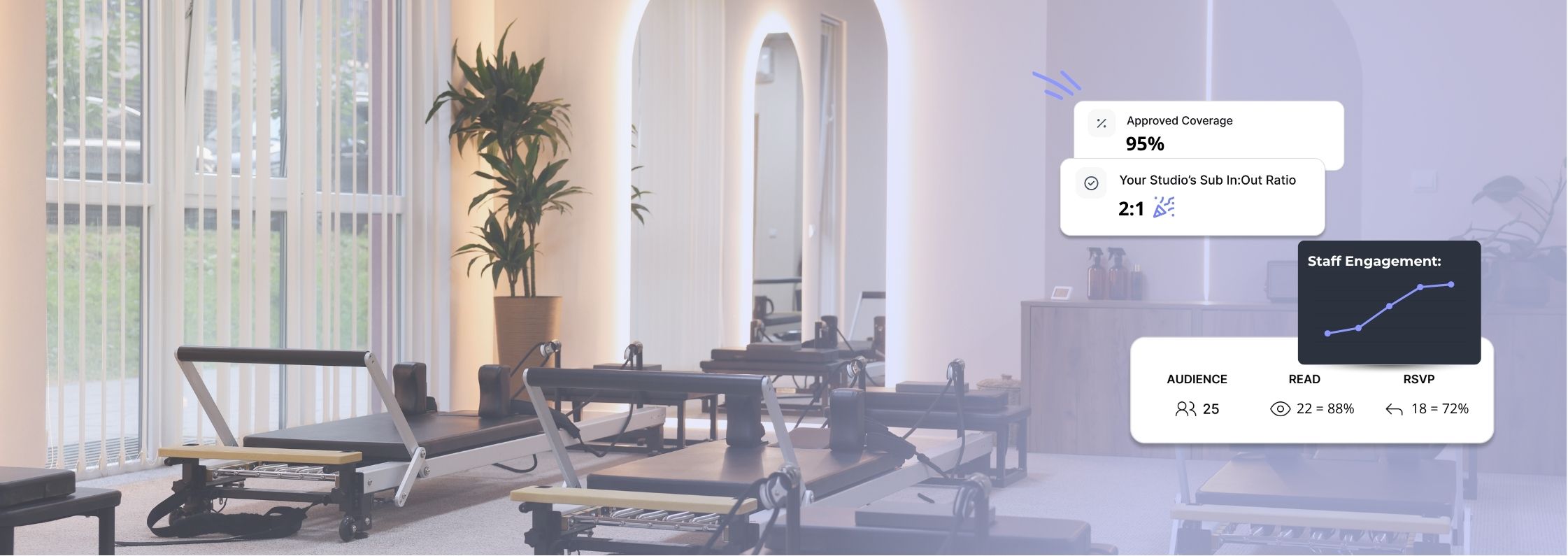
As we approach 2027, fitness studios and gyms face both exciting opportunities and mounting challenges: new technology, shifting member expectations, and stiffer competition, for members and for talent. To thrive, your operational systems need to be a catalyst for growth, not a bottleneck. Conducting some quick operational audits now can ensure your systems are ready to support your long-term goals.
And here’s a piece that’s easy to overlook: the systems running behind the scenes don’t just make your job easier, they shape what it’s like to work at your business. In a market where the best instructors often teach at several studios and can choose where to stay — and where great front-desk and sales talent is just as hard to keep — a professional staff experience has quietly become one of your strongest tools for hiring and retention. When The Box Lagree moved its team off group texts and onto a real staff platform, its instructors put it memorably: “We didn’t even know we were living in studio poverty until we came here and found out about NetGym.” Professionalizing your operations increases your ability to attract talent and protects the team you already have, a benefit that compounds at any size.
So this assessment zeroes in on the back-of-house engine: the staff operations that quietly power everything your members feel and everything that keeps your best people — instructors, front desk, and sales alike — on your team. Get the engine right, and the front-of-house has a lot more room to shine.
1. Assess Your Staff-Ops Workflows
Take a hard look at the systems your team runs on every day. Ask: do these help us scale, or slow us down? For each area, give your business a score from 1–5 (1 = a broken and chaotic system, 5 = optimized and scalable):
- Coverage & Subbing — Are sub requests, availability, and last-minute coverage handled smoothly and fairly, without you as the middleman?
- Staff Communication — Can your team quickly find what they need when they need it — and does your communication actually build culture? The best setups aren’t just one-way announcement boards; they enable the free-flowing conversation and connection that make a team feel like a team.
- Shift Management & Time Tracking — Does schedule clarity and easy coverage extend across your whole team (front desk, sales, admin — not just instructors), and can you and they track shifts and hours cleanly?
- Staff Onboarding & Training — Does every new hire get a clear, consistent path to ramp up, or are they left to figure it out based on who trained them?
- Documentation & Certifications — Are instructor certifications, insurance, and CPR current and tracked, with alerts before anything expires?
- Labor Compliance — Can your team trust that they’re being scheduled within the law and treated with respect? (overtime, breaks, and scheduling laws)
- Accountability & Task Completion — When something needs to get done, can you assign it, track it, and actually confirm it happened — or does it live in someone’s memory and a follow-up text?
- Insights & Staff Engagement — Do you have real visibility into how your team is doing — who’s engaged, who’s stretched thin, where energy and effort are going?
👉 How to use your scores:
5 = optimized: Congratulations! It’s time to maintain and monitor.
3–4 = functional but room to improve: You’re almost there, identify small tweaks or upgrades.
1–2 = urgent attention: It’s time to dive in! Prioritize these areas in your pre-2027 planning, as they’re most likely holding you back.
💡 Resource Alert: Our free Staff Time Audit Tool helps reveal where you and your team’s time is truly going so you can identify the broken (a.k.a. time-consuming) processes holding you back.
2. Gather Feedback from Staff
Your front desk, instructors, and sales staff see friction leadership never does — they live in these systems all day. Collect their input through surveys, quick check-ins, or a roundtable.
Look for:
- Daily workflow frustrations (the “why is this still so hard?” moments).
- Where communication breaks down or updates get missed.
- Ideas for process improvement — the people closest to the work usually have the best ones.
 Pro Tip: Quick questions sent through channels staff already use are most likely to elicit responses. Try NetGym polls to gather some quantifiable feedback.
3. Evaluate Your Staff-Ops Tools
The tools you rely on today may not carry you into 2027. Outdated or siloed systems lead to inefficiency, errors, and a worse experience for the team you’re trying to keep.
Evaluate whether your current staff-ops tools deliver on:
- Backend Efficiency — Does it reduce admin headaches, automate repetitive tasks, and free up staff time?
- Ease of Use — Is it intuitive for staff, minimizing support questions and driving adoption?
- Transparency — Does it keep staff and leadership aligned by making information accessible and easy to find?
- Visibility — Does it give you real-time insight into coverage, hours, and team behavior so you can make proactive decisions?
- Integrations — Does it work with the tools you already run on (your scheduling system and the rest of your stack), or force you into yet another disconnected silo?
- Fits Your Flows — Does it support the workflows you’ve already built and refined — and layer more automation and visibility on top — rather than making you start from scratch?
💡 NetGym Check: This is exactly where a purpose-built staff-ops platform earns its place and NetGym runs your entire back-of-house engine in one place. Automated subbing, a full communication hub, shift scheduling for every role, time clock, documentation and certification tracking, labor compliance alerts, a resource hub for training, tasks for accountability, and analytics across all of it — and it plugs into the scheduling system you already use (Mariana Tek, ClubReady, Mindbody, ABC/Daxko, etc.) so it strengthens your current flows instead of replacing them. If your existing stack can’t check the boxes above, that’s your signal for 2027.
4. Analyze the Metrics That Tell You How Your Team Is Really Doing
Data tells the story of whether your operation is thriving or just getting by but the fullest picture pairs the hard numbers (quantitative) with how your team actually feels (qualitative). Track the metrics below, then check them against what your team tells you directly through a quick NetGym poll or survey. The numbers show you what’s happening; your team shows you why.
- Coverage Reliability — How often do classes and shifts get covered without a scramble and how often do they not?
- Staff Retention & Turnover — Are you keeping your best people — instructors, front desk, and sales alike — or constantly re-hiring and re-training? (This is the metric your back-of-house systems quietly move the most.)
- Labor Efficiency — Are labor costs aligned with revenue, and how much staff time is going to low-value admin vs. growth activities? (Come back to that Staff Time Audit Tool.)
- Engagement & Accountability — Are updates being seen and acted on? Are tasks getting completed on time? Is sub work spread fairly, or landing on the same few people — an early burnout and turnover warning?
💡 NetGym Check: NetGym surfaces the staff-side signals most tools miss — communication read and response rates, task completion, shift and labor data, documentation status, and subbing behavior (who’s picking up classes, who’s sending constant urgent requests, who’s a team player). It’s real data for fairer evaluations, smarter scheduling, and spotting a disengaged or overloaded team member before they become a resignation.
5. Implement and Monitor Improvements
Turn insights into action by:
- Prioritizing changes by urgency and impact.
- Setting timelines, accountability, and clear ownership for each initiative.
- Monitoring improvements with ongoing reporting and check-ins.
💡 Pro Tip: Use NetGym Tasks to give each improvement an owner and a due date, so your 2027 plan has built-in accountability instead of living in a doc no one revisits. Assign it, track it, and check it off as a team.
6. Reassess Regularly
The fitness industry shifts quickly. An audit isn’t just for today — it’s a habit to develop. Build regular system reviews into your calendar so your business stays nimble, resilient, and ahead of the curve.
Position Your Team for 2027 and Beyond
Here’s the throughline: when your whole team — instructors, front desk, sales, and admin — knows exactly where to be, when to be there, and how to do their job to world-class standards, everything downstream gets easier. Your members feel it in every consistent, well-run visit, and your best people have every reason to stay. Professional staff operations aren’t a cost center; they’re how you deliver a world-class experience and protect the team that makes it possible.
And don’t forget the human side of those systems: a smooth new year starts with a team that’s set up to succeed. NetGym’s Resource Hub keeps your SOPs, policies, and trainings in one place — role-tagged, trackable, and always current — so every hire ramps up the same way and your standards don’t live in one person’s head.
Start your Pre-2027 Staff Operations Audit today, and then use NetGym to ensure your team’s time, systems, and energy are all aligned with your growth goals.
Brands that professionalize now will lead in 2027.